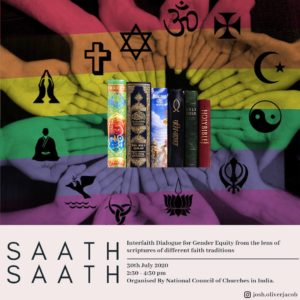
Click Here for Registration
The beautiful narrative of creation of human being is that we are tailor made by God, who is our creator and sustainer and even though has given us free will to choose but expects that we are more responsible for the choices we make. Often the choices we as humans make are for seeking the power and pleasure for ourselves. Later accounts portray such a self-seeking approach to distort the image of God in every human person and deform creation. One such distortion and deformation which plagues our society is gender inequality. The domination by the “mighty” who subjugates the “weak” is a challenge to balance of God endowed creation equality.
Religion is knowing God and following the faith we believe in. Religion plays a vital role in shaping cultural, social, economic, and political norms in many parts of the world. Thus, gender stereotypes and the status of women and men in society are deeply tied to the manner in which religious texts have been interpreted for centuries by those in positions of power—positions held predominantly by men.The relationship between religion and gender equality is a complex one. Yet, in sharp contrast to marked absence of all gender at the highest levels of decision-making in religious communities, women and all genders play a pivotal role in religious life. Within the family and the community, they implement and embody religious teachings and traditions, and pass these on to future generations. The role of faith-based organizations, institutions and actors in the gender equality agenda is multifaceted: while often rooted in patriarchal traditions, they are also among the powerful agents of social change. The language of faith reaches to the deepest roots of human motivation, mobilizing individuals and communities to sacrifice comfort and material wealth in pursuit of higher goals. In addition, faith-based organizations and institutions are among the largest, most stable, and well-resourced social networks.
Various faith Scriptures can play a vital role in re-establishing the balance in today’s world where Gender based inequality is rampant. We need to ask these vital questions: Is religion a barrier to gender equality? Distinction between (Institutionalised) Religion and what various Scriptures actually promote!
Saath – Saath looks forward to be a collaboration which is rooted in the understanding that in today’s world, where 8 out of 10 people identify as members of a religious or spiritual community, where religion exerts tremendous influence on people’s both women and men, identities, behaviours, and beliefs. As the oldest providers of social and humanitarian assistance, Faith-based organizations with their networks and resources reaching every corner of the globe are uniquely poised to impact the world in a more profound manner and set a more positive tone. Much more needs to be done for challenging the patriarchal structures, beliefs, and practices that have perpetuated inequality and discrimination against women and girls. While they have been instrumental in promoting spiritual, social, and physical wellbeing, faith-based organization still can be more proactive in engaging in the work of structural transformation required for secure equity and justice for all.
In “Saath – Saath’ we desire come together to look into our faith heritage captured in our scriptures. The desire is to reclaim the divinity of all human beings. Let us listen to what various scriptures say, with a purpose that faith leaders can be co-partners and collaborators in promoting and protecting Gender equity. Let us get inspired from our faith Scriptures and explore how Scriptures of various faith traditions preserve and promote Gender-parity.
Let’s Listen to what they have to say:
Dr A K Merchant is the national trustee Cum Secretary, Lotus Temple. A Doctor by Profession and very much active with social concern, he is a champion on topics like culture, religion and environment.
Tashi Choedup is a Queer Buddhist, monastic Buddhist philosopher and volunteering in Bodhgaya, Bihar. He is an activist and has been active in writing as well.
Rev M Jyothi Sunder is a ordained minister in Medak Diocese, CSI for 20 years. She had done her MTh in OT and MA in women Studies. She is also the President for Association of Theological Trained Women in India (ATTWI),
Ms Sribala Mylavarapu is a teacher of Sanskrit. She is staff at HMI, Hyderabad. She is programme officer for Academic Extension Programme. Her research topic is “Role of women in reconciliation in Faith Engagements”.
Ms Uzma Naheed is a member of Indian Muslim Personal Law Board and is a champion on Gender Justice. She has worked tirelessly for justice for women right from the Islamic context.
Ms Ashmeet Kaur Bilkhu is a young dynamic worker who has done her MPhil in “ Women and Gender Studies”. She is involved in developing curriculum at ISST for “ women And Work”. She writes on issues of gender politics and culture.
Dr Vihutoli Kinny is a lecturer at Nito Theological College, Nagaland. She is serving at department of Religion. Her research on doctoral studies was on : Social relevance of the religious thought of Swami Vivekananda today wit special reference to practical Vedanta.”
Ms D Reshma is working as an Assistant Professor at SSS, Shasun Jain College. She is a champion for the gender cause and has been dealing with many other issues as well. She has a special way on interacting with people of all age.
Mr Ankit Bhupati is a Human Right Activist and founder of Queer Hindu Alliance. He is a devout Hindu who finds his soul in Bhakti.
Let us join our panellist to be the voices of justice and equality. Let us ask questions not to others only, but to and for ourselves.
Let’s revisit and reclaim what is right.
Join in : Registration Form
Rev. Jyoti Singh Pillai
Executive Secretary, NCCI Women’s’ Concerns
For any Queries Please Contact: jyoti@ncci1914.com Or ncci@ncci1914.com
 Ecumenical news
Affirming Human Rights: Intercepting Human Trafficking International Youth Day Webinar Series
/24 Comments/in General news /by Communications29th July 2020 (Wednesday) 5:00 pm (IST)
Trafficking in persons is internationally defined criminal offence. Trafficking in human has been identified as the third largest source of profit for organized crimes, following arms and drug trafficking. Trafficking takes place for various purposes such as bonded labour, prostitution, forced marriages, domestic servitude, adoption, begging, organ trade, drug couriers, arms smugglings etc. and is an organized crime that gravely violates basic human rights. Human trafficking is not just a law enforcement issue, but a heinous crime which violates basic human rights, including their right to live with dignity and self-respect.
Trafficking in human beings covers various forms of coercion and exploitation of women, men and children. Responses to trafficking have traditionally focused on combating the criminal networks involved in it or protecting the human rights of victims. Young people, especially those with risk factors, are vulnerable to human trafficking. According to The United Nations Office for Drugs and Crime (UNODC) 51% of identified victims of trafficking are women, 28% children and 21% men; 72% people exploited in the sex industry are women; 63% of identified traffickers were men and 37% women; 43% of victims are trafficked domestically within national borders. According to a report by the National Human Rights Commission of India, 40,000 children are abducted each year, leaving 11,000 untraced. NGO’s estimate that between 12,000 and 50,000 women and children are trafficked into the country annually from neighbouring nations as a part of the sex trade.
In India, thousands of women, men and children are bonded to their employers, working for little or no wages because their earnings are retained in part or full to repay an outstanding loan. Many still work in agriculture, although bonded labourers are increasingly found in other sectors, including mining, brick making, textiles and domestic service. The victims of bonded labour tend to be drawn from the poorest and least educated segments of the population, from low castes and religious minorities – those who are vulnerable, excluded and voiceless. People in bondage are usually highly indebted to their employer. The debt results in pledging future labour for a few months, a year or longer periods; or may pass from one generation to the next.
This webinar will explore the ground realities and the aftermath of the atrocities done towards the humankind, and the way forward to intercept the violation of human rights.
Resource Persons:
Dr. M. Devasitham, MSW, PhD.
Associate Director, Strategic Development
International Justice Mission, Chennai
Rev. Sumith G Unni
Senior Associate, Community and Corporate Engagement
International Justice Mission, Mumbai
Click here for Registration
Jianthaolung Gonmei
Executive Secretary, NCCI Youth Concerns
Saath – Saath: An Interfaith Dialogue For Gender Equity from the lens of scriptures of different traditions
/23 Comments/in Appeal /by CommunicationsClick Here for Registration
The beautiful narrative of creation of human being is that we are tailor made by God, who is our creator and sustainer and even though has given us free will to choose but expects that we are more responsible for the choices we make. Often the choices we as humans make are for seeking the power and pleasure for ourselves. Later accounts portray such a self-seeking approach to distort the image of God in every human person and deform creation. One such distortion and deformation which plagues our society is gender inequality. The domination by the “mighty” who subjugates the “weak” is a challenge to balance of God endowed creation equality.
Religion is knowing God and following the faith we believe in. Religion plays a vital role in shaping cultural, social, economic, and political norms in many parts of the world. Thus, gender stereotypes and the status of women and men in society are deeply tied to the manner in which religious texts have been interpreted for centuries by those in positions of power—positions held predominantly by men.The relationship between religion and gender equality is a complex one. Yet, in sharp contrast to marked absence of all gender at the highest levels of decision-making in religious communities, women and all genders play a pivotal role in religious life. Within the family and the community, they implement and embody religious teachings and traditions, and pass these on to future generations. The role of faith-based organizations, institutions and actors in the gender equality agenda is multifaceted: while often rooted in patriarchal traditions, they are also among the powerful agents of social change. The language of faith reaches to the deepest roots of human motivation, mobilizing individuals and communities to sacrifice comfort and material wealth in pursuit of higher goals. In addition, faith-based organizations and institutions are among the largest, most stable, and well-resourced social networks.
Various faith Scriptures can play a vital role in re-establishing the balance in today’s world where Gender based inequality is rampant. We need to ask these vital questions: Is religion a barrier to gender equality? Distinction between (Institutionalised) Religion and what various Scriptures actually promote!
Saath – Saath looks forward to be a collaboration which is rooted in the understanding that in today’s world, where 8 out of 10 people identify as members of a religious or spiritual community, where religion exerts tremendous influence on people’s both women and men, identities, behaviours, and beliefs. As the oldest providers of social and humanitarian assistance, Faith-based organizations with their networks and resources reaching every corner of the globe are uniquely poised to impact the world in a more profound manner and set a more positive tone. Much more needs to be done for challenging the patriarchal structures, beliefs, and practices that have perpetuated inequality and discrimination against women and girls. While they have been instrumental in promoting spiritual, social, and physical wellbeing, faith-based organization still can be more proactive in engaging in the work of structural transformation required for secure equity and justice for all.
In “Saath – Saath’ we desire come together to look into our faith heritage captured in our scriptures. The desire is to reclaim the divinity of all human beings. Let us listen to what various scriptures say, with a purpose that faith leaders can be co-partners and collaborators in promoting and protecting Gender equity. Let us get inspired from our faith Scriptures and explore how Scriptures of various faith traditions preserve and promote Gender-parity.
Let’s Listen to what they have to say:
Dr A K Merchant is the national trustee Cum Secretary, Lotus Temple. A Doctor by Profession and very much active with social concern, he is a champion on topics like culture, religion and environment.
Tashi Choedup is a Queer Buddhist, monastic Buddhist philosopher and volunteering in Bodhgaya, Bihar. He is an activist and has been active in writing as well.
Rev M Jyothi Sunder is a ordained minister in Medak Diocese, CSI for 20 years. She had done her MTh in OT and MA in women Studies. She is also the President for Association of Theological Trained Women in India (ATTWI),
Ms Sribala Mylavarapu is a teacher of Sanskrit. She is staff at HMI, Hyderabad. She is programme officer for Academic Extension Programme. Her research topic is “Role of women in reconciliation in Faith Engagements”.
Ms Uzma Naheed is a member of Indian Muslim Personal Law Board and is a champion on Gender Justice. She has worked tirelessly for justice for women right from the Islamic context.
Ms Ashmeet Kaur Bilkhu is a young dynamic worker who has done her MPhil in “ Women and Gender Studies”. She is involved in developing curriculum at ISST for “ women And Work”. She writes on issues of gender politics and culture.
Dr Vihutoli Kinny is a lecturer at Nito Theological College, Nagaland. She is serving at department of Religion. Her research on doctoral studies was on : Social relevance of the religious thought of Swami Vivekananda today wit special reference to practical Vedanta.”
Ms D Reshma is working as an Assistant Professor at SSS, Shasun Jain College. She is a champion for the gender cause and has been dealing with many other issues as well. She has a special way on interacting with people of all age.
Mr Ankit Bhupati is a Human Right Activist and founder of Queer Hindu Alliance. He is a devout Hindu who finds his soul in Bhakti.
Let us join our panellist to be the voices of justice and equality. Let us ask questions not to others only, but to and for ourselves.
Let’s revisit and reclaim what is right.
Join in : Registration Form
Rev. Jyoti Singh Pillai
Executive Secretary, NCCI Women’s’ Concerns
For any Queries Please Contact: jyoti@ncci1914.com Or ncci@ncci1914.com
Preparing for the Good Work: NCCI CMAI Webinar on Pastoral Care in COVID times
/31 Comments/in Covid Resource, General news /by CommunicationsThursday 16th July 2020, 11 AM to 1 PM
Background:
The COVID 19 pandemic is growing to indescribable proportions. People on the ground, be it clergy, church goers or health care workers, are confronted daily with life realities related to health, social, economic and pastoral issues that need an immediate response.. The pandemic as we know affects the poor, the marginalised and those with co-morbid conditions disproportionately.
The solutions that have been offered to both the public and religious communities are to ‘go online’ and ‘lockdown’, practise hygiene and physical distancing. However, as we have become increasingly aware, these are solutions for those in the upper echelons of society. The poor need to earn a daily wage and cannot afford to be locked down. Children from poor families cannot be educated ‘online’ which is only going to spoil their future and that of the nation. Many communities in India don’t have water to wash their hands and use mud and ash even today. They live in single room homes and social distancing is not at all a practical solution for them.
Projections for the next few months are unpredictable. It is as if the worst is yet to come, and the bubble is about to burst. If in the days to come people, even those being tested positive for corona, are to be treated at home. Those who have been affected or infected by the virus are also facing intense stigmatisation which will further lead to people not accessing care.
As a church, who can we support ‘online’ and how can we address issues that need face to face interaction. The National Council of Churches in India (NCCI) in collaboration with The Christian Medical Association of India (CMAI) seeks to help Churches and Christian/ Ecumenical organisations be those Christ communities that are equipped with knowledge and skills in dealing with any eventuality both in families and as communities in neighbourhoods.
Objectives of the Webinar:
NCCI and CMAI seeks
Webinar Format:
Questions are invited NOW from prospective participants to the webinar on any questions, doubts and apprehensions that they may have on Pastoral care and counselling during COVID times. You can write this in the registration form. You can also write to cmaincciwebinar@cmai.org A panel of experts in the field of Law, Pastoral care and counselling will be providing information based on the questions raised.
Panel of experts
Proposed Date & Time
Thursday 16th July 2020, 11.00 am – 01.00 pm
Registration
Bishops, Pastors and Mission workers, Members of youth fellowships in churches, Christian health care workers who are willing to accompany such communities in their preparedness for the pandemic will attend. To attend the webinar, please register here
Most important:
If you have a question or doubt that you would like the panel of experts to discuss,
please write in registration form or mail to cmaincciwebinar@cmai.org
Rev. Asir Ebenezer Dr. Priya John
General Secretary NCCI General Secretary CMAI
“Living God’s Way” AISSA Zoom meet for Children
/24 Comments/in General news /by Communications26th June | 5 – 7 pm
Click here for registration
NCCI Webinar on Churches Accompanying Distressed Migrants to Life
/24 Comments/in General news /by CommunicationsMonday 22nd June 2020, 5.00 to 7.00 pm
The exodus of distressed migrant labourers during the lockdown period problematises the dominant narratives that exist on the working class in India. While it exposes the irresponsible attitude of labour contractors and democratic governments- both state and centre, towards the unorganized labour sectors, it also highlights the need to revise labour laws to favour this segment of workers who constitute more than a hundred million of the population. However, the firm decision taken by workers to transcend the apathy of Government structures and systems by adopting alternate ways of returning home, including walking and cycling thousands of miles, demonstrates their lack of confidence in Government machineries. Their exodus shows their endurance and persistence to function as an agency of change.
Many have returned to the places they call ‘home’, their own native lands, their State of origin, posing many questions before the civil society. What will their future be? Will they go back and continue to experience the same pathos of modern slavery or will they negotiate with contractors, entrepreneurs and the Government regarding their dignity as labourers. If they do not come back to their respective areas of work, will they lead a meaningful and a dignified life without having a regular income? Will the Government develop supportive systems at the point of origin to sustain their life? These labourers are a faith question before the church- the ‘ekklesia’. Being a radical democratic assembly of God, the church has to see this as a crisis emerging out of the unjust structures of the society. The majority of these workers belong to Dalit, Adivasi and OBC communities. Therefore, their marginalisation has caste, colour, economic and gender dimensions and intersections.
The Church is supposed to be the voice of the marginalised and has a responsibility to visualize an inclusive society – a society which has equity and where equal distribution and justice are the core values. A webinar is scheduled to discuss how the church can journey with those in exodus, to learn from them and to be with them in their plight. It is an exploration to evaluate the role of the church in the context of the exodus of distressed migrant workers.
The webinar will attempt to (1) seek an understanding on the context of the exodus of distress migrants to their own places, (2) seek to learn ways in which the church can affirm and enhance their quality of life in the locales to which they have returned and to which spaces they will eventually return again after the CoVID context wanes out, and (3) motivate Churches, Christian and Ecumenical organizations to make their plan of action in this regard. Meera Sangmitra (NAPM), Sonia George (SEWA), Dr S.K Vettivel (Independent Consultant), Indrajeet Pawar (IJM) and Rajesh Jadhav (NCCI-URM/ VCLC) who are experts in their respective fields will guide us through the webinar. The webinar will be held on 22nd June 2020 between 5.00 and 7.00 pm
Click here to register for the webinar. A confirmation mail with dial in details will be sent subsequently.
Team NCCI.
NCCI CMAI Webinar on Youth and Mental Health in the Context of COVID-19
/25 Comments/in Covid Resource, General news /by CommunicationsRebooting as Ekklesia Series:
Youth and Mental Health in the Context of COVID-19
13th June 2020 (Saturday) 05:00 pm (IST)
In January 2020 the World Health Organization (WHO) declared the outbreak of a new coronavirus disease, COVID-19, to be a Public Health Emergency of International Concern. Subsequently in March 2020, the WHO made the assessment that COVID-19 can be characterized as a pandemic. Ever since, the outbreak of COVID-19 throughout the world has caused public panic and mental health stress, with an increasing number of cases being diagnosed and public concerns about infection. The ripples of this pandemic have spread out affecting the public and individuals resulting with interconnected effects on the socio-economic, mental, and physical well being. The society, particularly the young people into experience psychological problems such as post-traumatic stress disorder, psychological distress, depression, anxiety, and even death due to loss of jobs, failure of business, disturbance of education (even to the loss of academic year), loss of family members, social lockdown and the restrictions that affect their way of ‘normal’ day to day life.
In India, 65% of the population is less than the age of 35 years and 50% below 25 years of age. These young people are the backbone of the country and at this moment in time of pandemic many of them are undergoing mental breakdown. The social and economic fissures exposed by the pandemic have already caused in unemployment, depleted social safety nets, starvation, among other things among the young people. This post-COVID landscape becomes a fertile breeding ground for an increase in chronic stress, anxiety, depression, alcohol dependence, and self-harm in which the young people have fallen victim.
The Church, Church-based organizations and the faith community as a whole have a great role in rebuilding the holistic well being of the society and individual particularly the young people in both clinical/scientific approach and pastoral care. We will reconnoitre the means and ways from the resource persons during the webinar.
Resource Persons:
Dr. Kimneihat Vaiphei
Asst. Professor,
Department of Psychiatric Social Work
NIMHANS, Bangalore
Rev. Dr. Israel David
Asst. Professor,
Department of Christian Ministry
Union Biblical Seminary, Pune
Click here for registration.
Download Concept Note
NCCI Webinar on COVID, LGBTIQ Communities and the Church
/24 Comments/in News from NCCI /by CommunicationsWednesday June 10th 2020, 5.00 pm to 7.00 pm
The COVID – 19 lockdown continues in the country, despite measures to relax it in phases. Various marginalized communities are undergoing struggles detrimental to their survival. Among such groups of people the LGBTIQ communities have been facing different types of struggles during this time, adding to their ongoing struggles with stigma and discrimination on various fronts. This needs attention from various stakeholders and duty bearers.
The National Council of Churches in India (NCCI), has in the past facilitated faith communities engage with the LGBTIQ communities. This it did through its ESHA Project and its National forum called the National Ecumenical Forum for Gender and Sexual Diversities (NEFGSD). Even during the lockdown the NCCI has been engaged in addressing the concerns relating to LGBTIQ communities. These experiences push one to think that the Church at large should start working on the concerns of these peoples.
On behalf of the NCCI, and as part of its ‘Rebooting as Ekklesia’ series of webinars, the ESHA Program and the NCCI National Ecumenical Forum for Gender and Sexual Diversities (NEFGSD) is offering a platform for Churches to engage with the community and discern a mission agenda and priority for engagement. It is hoped that this offering will open different avenues of engagement between the Church and the people belonging to one or all of the LGBTIQ communities.
What we want to do
To understand the difficulties of the LGBTIQ communities that became compounded during the situation as COVID and the lockdown.
To discern a call of the times in the contexts of peoples with different sexual orientations and gender identities.
To list specific areas of relevant and appropriate engagements of churches in such contexts.
How we propose to do that . . .
Listen to the lived experiences during the lockdown from representatives of LGBTIQ people (Ms Santa Khurai, Mr Rohan Regi Mathews, Dr Anand Chandrani, Mx Gopi Shankar, Ms Sonal Giani)
Consolidate the voices, acknowledge responses and suggest more possibilities for collaboration (Dr L. Ramakrishna , Ms Rachana Mudraboyina).
Discern a way forward (Fr Dr Reji Mathew, Rev Dr Sunil Caleb, Rev. Solomon Paul, Rev Priscilla Rawade)
Click here for registration.
Webinar date: Wednesday June 10th 2020 (5.00 pm to 7.00 pm).
You will receive a zoom link when your registration is accepted.
NCCI WCC Webinar on Sustainable Environment: Churches in Action. June 4, 2020
/24 Comments/in General news /by CommunicationsWorld Environment Day Webinar on
Sustainable Environment: Churches in action
(NCCI’s Rebooting as ekklesia series)
Thursday June 4, 2020 Thursday, 2:30PM- 4:30 PM (IST)/ 11.30– 13.00 (CET)
“The earth is the LORD’s, and everything in it, the world, and all who live in it; –Psalm 24:1
The theme for World Environment Day, 5 June 2020 is biodiversity — a call to action to combat the accelerating species loss and degradation of the natural world. One million plant and animal species risk extinction, largely due to human activities. According to the WWF, Humanity has wiped out 60% of mammals, birds, fish and reptiles since 1970. Some recent analyses have revealed that humankind has destroyed 83% of all mammals and half of plants since the dawn of civilisation.The global economy is intricately tied to biodiversity. Services provided by biodiversity are worth an estimated US$ 125-140 trillion per year, more than one and a half times the size of global GDP. The food we eat, the air we breathe and the water we drink come from nature.
In a country like India, with world’s second highest population and an increased demand for economic growth coupled with rapid urbanization trend, the process of biodiversity loss is on a fast track, resulting in increased frequency of extreme weather events, successive droughts, lack of drinking water, crop failures, etc. This has severe impact on the poor and the agrarian communities, whose life and livelihood depends on nature and biodiversity.
So what can be done?
The WED this year has focused on “time for nature”. The world has come to a standstill due to the COVID-19 pandemic. At this time of lockdown measures, the world witnessed a significant reduction in greenhouse gas emissions around the world and the nature found its “breathing space”. In a way the nature reclaimed its space! But for how long? How does a post COVID-19 world or the nature look like? All is not lost and its not too late. We can reverse the trends of biodiversity loss by reimagining our relationship with nature and acting now to increase ambition and accountability for its protection. But all stakeholders have to respond collectively.
Who are the stakeholders? what changes needs to be done? As a faith community, what role churches can play? Let us hear some success stories and explore together with the panel of speakers:
Dinesh Suna, EWN, WCC
Manoj Kurian, EAA, WCC
Athena Peralta, EEJ, WCC
Renemsongla Ozukum, CBCNEI /NCCI
Angelious Michael, JELC/ NCCI
Mathew Koshy, CSI/ NCCI
The webinar will be facilitated by Asir Ebenezer, General Secretary NCCI and Pradip Bansrior. Executive Secretary NCCI Dalit and Adivasi/Tribal Concerns
Register here for joining the webinar on Zoom platform. The zoom link and password to join the webinar will be sent to you subsequently
On the occasion of Id-ul-Fitr . . .
/24 Comments/in General news /by CommunicationsOn the occasion of the Id-ul-Fitr, the National Council of Churches in India wishes fellow pilgrims of the Islamic faith good health and cheer, and all prosperity that God promises to bestow upon them and all of humanity.
May the acts of love and charity represented in the zakat, and submission to the teachings of the Holy Prophet (peace be upon him) as revealed in the Holy Quran, guide the community in its faith and witness, accompanied by the Angels for the glory of the One Holy God.
We are mindful of the communitarian aspect of the faith and the festivities that have to be curtailed on account of the recommended COVID related physical distancing and restrictions on gatherings. Despite the subdued celebration of the conclusion of the fast, we wish the community every joy and happiness on this day.
May God Almighty Most Beneficent and Most Merciful guard and guide the steps and destiny of every Muslim in this country and allover the world. May the spirit of Islam enrich our country and the World, and add meaning to the shared pilgrimage of all life on earth.
National Council of Churches is the National Platform of 30 Nation-wide Churches, 18 Regional Councils of Churches, 18 All India Christian Organisations, 7 Related Specialised Professional Agencies, and 2 Autonomous bodies, that is constituted for ecumenical learning and action.
Rev. Asir Ebenezer
General Secretary, NCCI
CASA continues interventions amidst lockdown
/25 Comments/in News from Constituent Members /by CommunicationsThe Church’s Auxiliary for Social Action (CASA) has been continuously striving to mitigate the sufferings of the poor during the lockdown announced to combat COVID 19. We present here CASA’s second SitRep, along with the covering note of its Director Dr. Sushant Agrawal. We are proud of him and his dedicated team of staff and volunteers. We wish them God’s protection and accompaniment.
Rev. Asir Ebenezer
General Secretary NCCI