
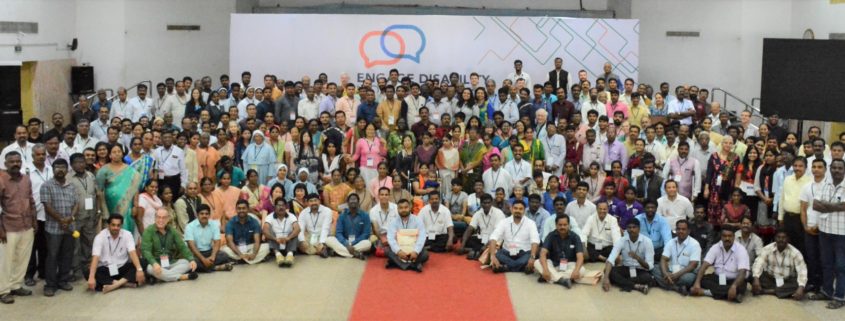
DECLARATION by Engage Disability Partners
During the Engage Disability Conference 2014, NCCI-IDEA was called on to lead the Regional Hub Engage Disability in India. NCCI-IDEA is also one of the core members of Engage Disability Advisory Committee and was also the acting secretariat for Engage Disability 2014-2016. Rev. Christopher Rajkumar, the executive Secretary of NCCI and director of IDEA served as the Chairperson of Engage Disability, India so far.
DECLARATION by Engage Disability Partners
We believe…
As the Body of Christ, we affirm that all people, including people with disabilities, are created in the image of the Triune God. The church is “OF” all and “FOR” all. Thus, a church that excludes persons with disabilities is incomplete. The Body is made up of different parts and the seemingly weaker parts are indispensable. (1 Cor. 12:22)
The Mission of God is an imperative;along with and for the disabled; who have potential to be full and active members of the Church, community and society at large.
We repent…
For treating the person with a disability as an object of charity; or of a lesser class. Though disability is prevalent in the world, it is less prevalent in the church. We have accepted traditions and imposed structures, processes and attitudes which prevent those who are affected by disability from accessing the church, the Christian community—and our own programs in India. If we are not actively including people with disabilities, we are passively excluding them;and we have missed the opportunity to show the heart of the Gospel.
We are challenged…
By the Gospel of Christ, in establishing the “reign of God” to work toward justice, love and peace for all; including persons with disabilities. We are motivated by the holistic healing narratives in the Gospels to minister both to and alongside persons with disabilities. For us as a community of Christian faith, it is a mandate that we accompany one another in reaching the highest potential for which God created us.
We are guided by Christ…
Who furthered this message by coming “to preach good news to the poor and proclaim freedom for the prisoners and recovery of sight for the blind…to release the oppressed.” (Luke 4:14-21) Jesus saw people with disabilities, challenged their marginalization; and He responded with Love. He showed great concern for both physical and mental challenges as He addressed their spiritual condition.
We are committed to:
- Stand with our Brothers and Sisters who have disabilities, ensuring that they are centrally involved in this process and movement.
- Promote inclusion of those with disabilities in all aspects of the church, our programs, and community.
- Further a theological understanding of disability: that ALL are created equal and in the image of God; and that disabilities are not a result of a person’s sin, lack of faith, or an unwillingness to be healed
- Engage together for advocacy and inclusion of persons with disabilities in their local communities and society at large
- Be personally and corporately blessed by people with disability serving alongside those without disability
We are guided by the Scriptures…
- We value people as being created in God’s image and as being called to abundant life
“For You formed my inward parts…I will praise you for I am fearfully and wonderfully made…” (Ps. 139: 13, 14)
“I have come that they may have life and that they may have it more abundantly.” (John 10:10)
- We acknowledge that God’s purposes are often worked out through those whom the world has rejected and despised.
“…God composed the body, having given greater honor to that part which lacks it…” (1 Cor.12:24-25)
“…My strength is made perfect in weakness…” (2 Cor. 12:9)
- We acknowledge that societal structures, including those in Christian communities, can prevent God’s people from playing a full role in the body of Christ.
“Is not this the kind of fasting I have chosen: to loose the chains of injustice and untie the cords of the yoke, to set the oppressed free and break every yoke?” (Isaiah 58:6)
“The Spirit of the Lord is on me, because he has anointed me to preach good news to the poor. He has sent me to proclaim freedom for the prisoners and recovery of sight for the blind, to release the oppressed” (Luke 4:18)
- We value team work and acknowledge that the body of Christ is incomplete without our Brothers and Sisters affected by disabilities.
“…in whom the whole body is united and held together by every ligament with which it is supplied. As each individual part does its job, the body’s growth is promoted so that it builds itself up in love.” (Eph. 4: 16)
“But in fact God has arranged the parts in the body, every one of them, just as he wanted them to be” (Corinthians 12:18)
- We believe that we are loved by God and are called to express His love to others, including those who are marginalized. We exhibit this love through both word and deed.
“This is My commandment, that you love one another as I have loved you” (John 15:12) “Open your mouth, judge righteously, and plead the cause of the poor and needy” (Prov. 31:9)
Conclusion
If persons with disabilities are a full part of our church, then we will be blessed
There is blessing when we include those with disability in the church, our programs and in our communities where we work. Created in the image of God, they can enjoy the right to “wholeness”; no longer simply being objects of our benevolence, but enabled to be “givers” themselves. In this way, our paradigm shifts from giver-receiver mode to the “accompanier”mode; and as a result, we all can truly experience abundant life. 1Corinthians 12:22 says that the seemingly weaker parts of the body are indispensable. Luke 14:13 says, “Invite some people who never get invited out, the misfits those with disability,. You’ll be—and experience—a blessing”.
– Cynthia Shinde
Coordinator, Indian Disability Ecumenical Accompaniment (IDEA),
National Council of Churches in India.
Joint Ecumenical Statement by ACT, WCC, LWF to the 62nd Commission on the Status of Women
Joint Ecumenical Statement by Action by Churches Together – ACT Alliance (ACT), Commission of the Churches in International Affairs of the World Council of Churches (WCC), and Lutheran World Federation (LWF) to the 62nd Commission on the Status of Women
As networks of Churches and Christian faith based organizations working for decades in humanitarian response and human rights-based development in over 130 countries, we call for an end to gender inequality and injustice. Our faith inspires us work to address the needs not only of the body but also of the mind and spirit, honoring the fullness of humanity. We also extend into the most rural areas that are often out of the institutional reach of national governments. We welcome the Commission’s acknowledgment that the specific challenges of women and girls living in rural communities must be addressed in order obtain gender justice for all. These challenges must be particularly addressed in line with the framework of the Sustainable Development Goals and Agenda 2030 to ensure that those most marginalized, such as rural women and girls, are not ‘left behind’.
Working with Faith Actors to End Harmful Practices
United Nations mechanisms such as the Convention for the Elimination of Discrimination Against Women (CEDAW), the Universal Periodic Review (UPR), and the Committee on Economic, Social and Cultural Rights (CESCR), show that a number of customary laws and the misuse of religious practices beliefs threaten progress, particularly concerning rural women and girls’ rights, even within countries that have ratified treaties and committed to implementing human rights standards. For example, in Sierra Leone, up to 85 percent of the population uses customary law as part of the formal and informal legal system. Moreover, civil unrest in a country can weaken formal justice systems; in such situations, the population might resort to traditional dispute settlement mechanisms, which complicates and may preclude the assurance of the rights of women and girls, particularly in rural communities.
Acknowledging that these customary and traditional practices are rooted in convictions, values and beliefs, the importance of deliberately involving religious leaders of different faiths cannot be overemphasized. Such leaders play critical and influential roles within society and people of all age groups in communities rely on them for guidance on many matters. As such, working with faith based actors has the potential to bring lasting and sustainable change to end harmful traditional practices including female genital mutilation/cutting and child, early and forced marriage.
Rohingyas: Statement on the Human Rights of Stateless People
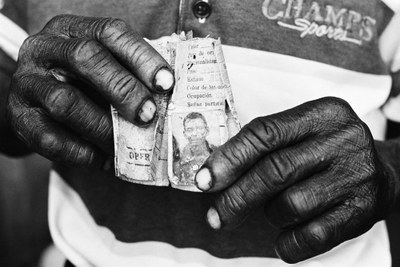
In the light of the plight of the Rohingya people, all churches are hereby reminded of the Statement on the Human Rights of Stateless People adopted by the WCC 10th Assembly as part of the Report of the Public Issues Committee adopted by the WCC 10th Assembly as part of the Report of the Public Issues Committee. Please take special note of the last section of the statement. May we all stand up for our commitment to just and inclusive communities!
Rev. Dr. Roger Gaikwad,
General Secretary, NCCI
Statement on the Human Rights of Stateless People
Adopted by the WCC 10th Assembly as part of the Report of the Public Issues Committee.
Nationality is a fundamental human right which is affirmed in article 15 of the Universal Declaration of Human Rights and is a foundation of identity, human dignity, and security. Nationality is an essential prerequisite to the enjoyment and protection of the full range of human rights.
Currently, there are more than ten million people around the world who live without any nationality: they are stateless people. Most of these stateless people have not left their country of origin.
Statelessness can occur for a number of reasons. Some relate to technical aspects of nationality laws and procedures for acquisition of documents which prove nationality. More often, however, the cause is discrimination. Minorities are often arbitrarily excluded from citizenship due to discrimination on racial, ethnic, religious or linguistic grounds.
This kind of discrimination in the nationality law has rendered stateless more than 800,000 Rohingya, an ethnic Muslim minority living in Rakhine State, despite their ties to Myanmar that date back centuries. Over the past 30 years, the Rohingya have been subjected to widespread discrimination including the denial of citizenship, denial of freedom of movement and the right to marry. They have suffered forced labour and detention. As a result of discriminatory conditions inside the country, more than 200,000 Rohingya have fled to neighbouring Bangladesh, though fewer than 30,000 are officially recognized as refugees. Most unregistered Rohingya live in unofficial makeshift refugee settlements, where shelters are falling apart, and malnutrition is widespread. In spite of these conditions, aid agencies have sometimes been denied permission to assist unregistered refugees. Without residence or work permits, unregistered refugees live in fear of detention and forced repatriation to Myanmar. The lack of documentation also makes Rohingya women and girls particularly vulnerable to physical attacks, sexual violence and trafficking. Rohingya populations are also found in the Gulf countries and many have made the perilous sea journey to other countries in Asia – or have died trying.
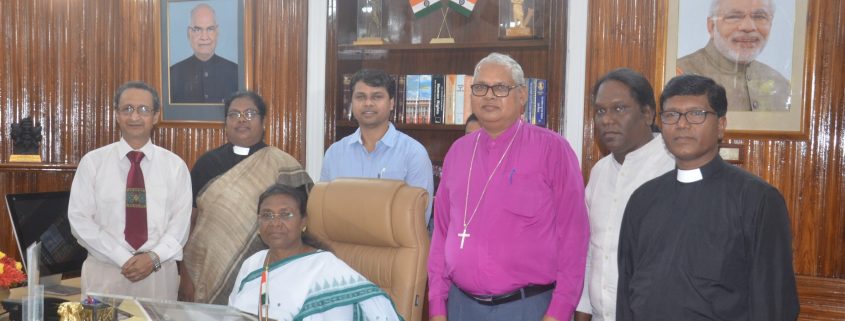
Memorandum submitted to the Governor of Jharkhand to repeal the proposed religious freedom bill and the amendments to the land acquisition bill.


Bishop Johan Dang (Moderator, GEL Church), Bishop Dular Lakra (NWGEL Church), Rev. Dr. Roger Gaikwad (General Secretary, NCCI), Mr. Pradip Bansrior (Executive Secretary, Dalit & Tribal / Adivasi Concerns, NCCI), Mr. Joy Tudu (Secretary, Santalia Council of Churches), Rev. Arun Barwa (Secretary, Jharkhand Council of Churches), and Rev. Ashisan Bage (Women Representative).
These leaders submitted a memorandum to the Governor of Jharkhand to repeal the proposed religious freedom bill and the amendments to the land acquisition bill.
Text of the memorandum:
To
Her Excellency,
Shrimati Draupadi Murmu
Governor of Jharkhand
Raj Bhawan, Ranchi – 834001
Jharkhand
Subject: An appeal to Repeal the Jharkhand Freedom of Religion Bill2017 and Jharkhand Right to Fair Compensationand Transparency in land Acquisition, Rehabilitation and Resettlement (Ammendment) Bill 2017by the Jharkhand Vidhan Sabha on 12th August 2017.
Honorable Governor Shrimati Draupadi Murmu,
We, as citizens of India and on behalf of National Council of Churches in India, Jharkhand Council of Churches and Santalia Council of Churches bring our greetings of respect, love and joy to you. The Jharkhand assembly on 12th August 2017 passed the Jharkhand Freedom of Religion Bill2017 and Jharkhand Right to Fair Compensationand Transparency in land Acquisition, Rehabilitation and Resettlement (Ammendment) Bill 2017 brought by the BJP-led government. During the debate on Religious Freedom Bill 2017in theassembly, a figure was presented by the BJP led government, which states that in 2011 there were 10,90,283 Christians in Jharkhand which rose to 14,18,783 in 2017 which means in the last five years an increase of 30 percent in the population of Christian religion. According to Indian government census report it was 4.1 percent of the population who accepted Christianity in 1951 in Jharkhand, which rose 4.3 percent in 2011, i.e. an increase of just 0.2 percent of the population of Christians in 70 years. Your Excellencyan increase of30 percents in just five years is just impossible; it is only a politically motivated inflated figure.In India, as per the government census the Christian population in the country was 2.33 per cent in 1951; 2.44 in 1961; 2.60 in 1971; 2.44 in 1981; 2.32 in 1991; 2.34 in 2001 and 2.30 in 2011. The growth rate is almost static. Jharkhand has the same kind of scenario too. Though the State was formed in 2000, yet for a larger picture the Christian population was 4.12 in 1951; 4.17 in 1961; 4.35 in 1971; 3.99 in 1981; 3.72 in 1991; 4.10 in 2001 and 4.30 in 2011. Here too the growth rate is stagnant. The census occurs once in every ten years. How could the Jharkhand government introduce its figure on Christian population percentage to the assembly? The BJP led government has misled the assembly by introducing fake figures. Is this not a travesty of democracy?

Independence Day 2017 – Open letter to The Prime Minister of India
To,
Shri Narendra Modi,
The Prime Minister of India.
Dear Prime Minister,
Greetings!
On Good Friday 14th April 2017 (The Day commemorating the Crucifixion of Jesus Christ, instigated by the communal minded right wing religious and political leaders of the time), I had written an open letter to you expressing my concern as an Indian citizen about the state of affairs in the country. Perhaps you were too busy to respond to that letter or you thought it unnecessary to respond to an ordinary Indian citizen’s mann ki baat (which I could not transmit on national communication systems).
This time I write to you as an Indian spiritual seeker of God’s reign of justice, love and peace in our beloved country India. As all Indians go on to celebrate Independence day on 15th August 2017, and as we keep on hearing statements which stereotype Christians as being aliens or as being people whose patriotism is questioned, I would like to draw your attention to a very strong statement (with my added emphasis) made on “Church and State in Post-War India” by the National Council of Churches in India (an ecumenical body of Indian Protestant and Orthodox Tradition churches representing around 14 million Christians today) in its Council meeting in 1944[1]:
NCCI letter to Prime Minister of India
August 3, 2017
To,
Shri Narendra Modi,
Honourable Prime Minster of India.
Dear Prime Minister,
Greetings to you from the National Council of Churches in India!
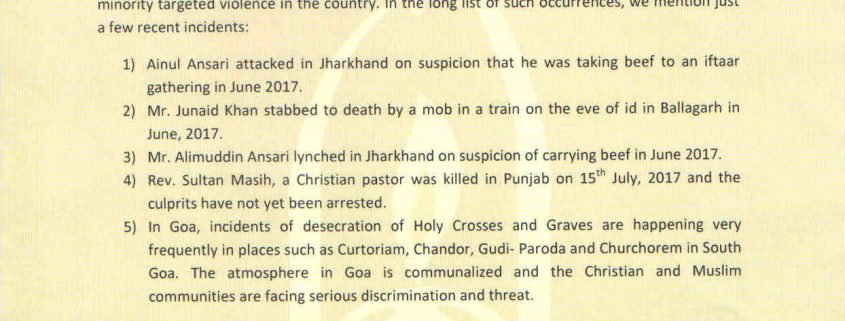
Your good self and indeed all the citizens of the country are well aware of the phenomenon of minority targeted violence in the country. In the long list of such occurrences, we mention just a few recent incidents:
- Ainul Ansari attacked in Jharkhand on suspicion that he was taking beef to an Iftaar gathering in June 2017.
- Junaid Khan stabbed to death by a mob in a train on the eve of Id in Ballagarh in June, 2017.
- Alimuddin Ansari lynched in Jharkhand on suspicion of carrying beef in June 2017.
- Sultan Masih, a Christian pastor was killed in Punjab on 15th July, 2017 and the culprits have not yet been arrested.
- In Goa, incidents of desecration of Holy Crosses and Graves are happening very frequently in places such as Curtoriam, Chandor, Gudi- Paroda and Churchorem in South Goa. The atmosphere in Goa is communalized and the Christian and Muslim communities are facing serious discrimination and threat.
We are deeply disturbed about the various expressions of vigilantism in different parts of our Country. We strongly condemn incidents of lynching and mob violence, particularly against Muslims and Dalits. In fact minority communities are experiencing horrendous forms of Symbolic, Structural and Physical violence. Such occurrences not only corrode the secular ethos of our Country but also tarnish the name of India in the international sphere. On the one hand while we are boasting about our technological and economic development, our record in human relational secular development is not so laudable.
What makes us feel so exasperated is that the State and Central Governments are not taking severe action against the different expressions of vigilantism. Mere words of condemnation are not enough. We are horrified that various states are bringing severe anti cow slaughter acts where as there is so much reluctance to bring in anti lynching / mob violence acts and to implement them. Unfortunately, because of the link of vigilantes with political parties and cultural originations, state mechanisms are afraid to take action against them. Some of our national leaders keeping asserting that “law and order” is a state subject; nevertheless the Centre needs to pressurize the states to act. Since governance of the country in our times revolves around you, we strongly urge you to bring in a new act to address the present situation or execute severe action against perpetrators of violence using the existing laws.
At the same time the churches are deeply pained about the killing of 7 Amarnath Yatra Pilgims by terrorists. We urge you to provide more security to the pilgrims and bring the culprits to the law.
Therefore we call upon you to take effective positive steps for the inclusive multi-dimensional development of all the communities in our beloved country, India.
We also assure you the Christian community continues to pray for the country and to contribute to its all round development.
Yours sincerely,
SD/-
Rev. Dr. Roger Gaikwad,
General Secretary, NCCI.

Letter to Prime Minister of India | August 3, 2017 | Page 1 of 2

Letter to Prime Minister of India | August 3, 2017 | Page 2 of 2
NCCI Letter to President of India
August3, 2017
To,
Shri Ram Nath Kovind,
Honourable President of India.
Your Excellency,
Greetings to you from the National Council of Churches in India (NCCI)!
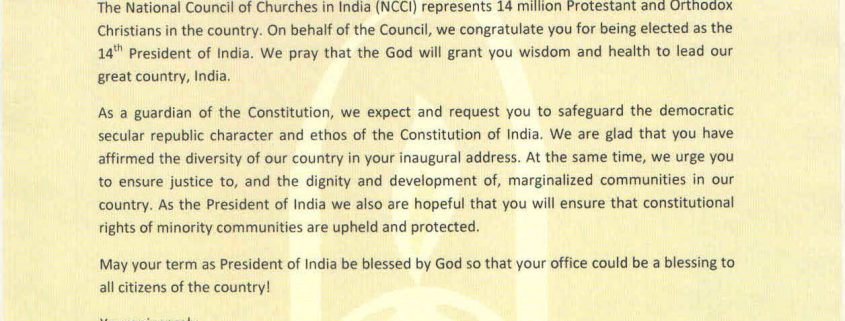
The National Council of Churches in India (NCCI) represents 14 million Protestant and Orthodox Christians in the country. On behalf of the Council, we congratulate you for being elected as the 14th President of India. We pray that the God will grant you wisdom and health to lead our great country, India.
As a guardian of the Constitution, we expect and request you to safeguard the democratic secular republic character and ethos of the Constitution of India. We are glad that you have affirmed the diversity of our country in your inaugural address. At the same time, we urge you to ensure justice to, and the dignity and development of, marginalized communities in our country. As the President of India we also are hopeful that you will ensure that constitutional rights of minority communities are upheld and protected.
May your term as President of India be blessed by God so that your office could be a blessing to all citizens of the country!
Yours sincerely,
SD/-
Rev. Dr. Roger Gaikwad
General Secretary, National Council of Churches in India.

Letter to President of India | August 3, 2017
NEICC letter to the Ministry of Law and Justice with reference to report no. 267 of the Law Commission of India.
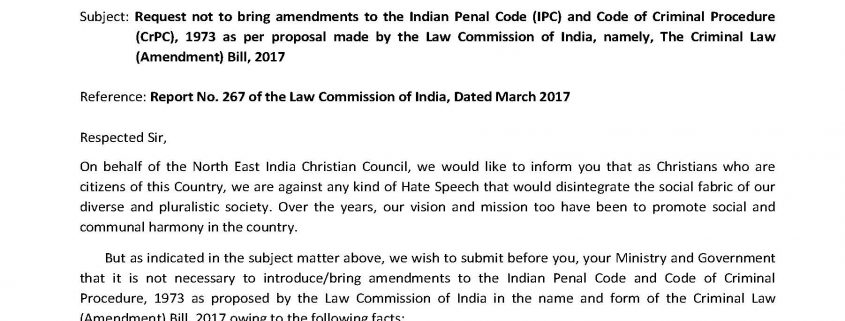
North East India Christian Council (NEICC), a regional council of the National Council of Churches in India (NCCI) has written a letter (see below) to Shri Ravi Shankar Prasad, Cabinet minister, Ministry of Law and Justice of the Government of India requesting not to bring amendments to the Indian Penal Code (IPC) and Code of Criminal Procedure (CrPC), 1973 as per proposal made by the Law Commission of India, namely, The Criminal Law (Amendment) Bill, 2017. This is with reference to Report no. 267 of the Law Commission of India dated March 2017.
Rev. Dr. Roger Gaikwad, General Secretary of NCCI appreciates NEICC for the initiatives they are taking. Since it is important to communicate and make known our concerns, he urges Churches and councils to write on specific issues and concerns to corresponding authority bodies. Read more
Statement of United Christian Forum of North East India (UCFNEI) on the portrayal of Jesus as “demon”.
19th June, 2017.
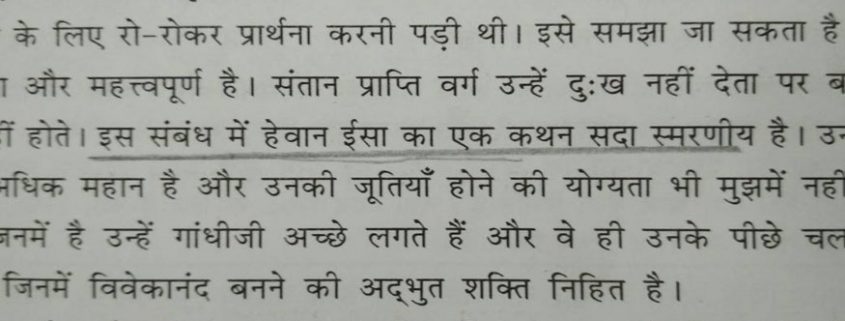
The United Christian Forum of North East India (UCFNEI) takes serious objection to the portrayal of Jesus as “demon” in the Class 9 Hindi language text book published by the Gujarat State School Textbook Board (GSSTB). The 16th Chapter of the book entitled “Bharatiya Sanskriti me Guru-Shishya Sambandh” on page number 69 reads: “Is sambandh me „haivaan Issa‟ ka ek kathan sada smaraniya hai” (In this context, a statement by ‘demon Jesus’ is always memorable). These words in the text book have shocked and deeply hurt the sentiments of Christian Community and of all people who respect the religious beliefs of all the communities in the secular State. One fails to understand the wisdom behind such a derogatory depiction of Jesus, who is revered by Christians in India and all over the world, as their Saviour and by many others like Mahatma Gandhi as a religious leader. The UCFNEI notes with utmost pain such caricaturing of Jesus.
Apart from hurting the sentiments of the Christian Community, the said chapter grossly misrepresents the person of Jesus and provides erroneous information to children. The GSSTB, which should have taken trouble to provide correct historical information, has erred in executing its duty. One gets a feeling that it is a deliberate attempt to malign a minority group. This statement comes not from a fringe fundamentalist group but from an official body of the Government of Gujarat. We are shocked to see an official body of the State taking such a stand.
The UCFNEI strongly objects to such an attempt of the GSSTB and demands that the text book be immediately withdrawn. It also demands an apology from the GSSTB and from the Government of Gujarat to the Christian Community.
| SD/-
FR. G.P. AMALRAJ |
SD/-
REV. R. LALNUNZIRA |
| SD/-
REV. DR. SOLOMON RONGPI |
SD/-
REV. ROLIANTHANG LALSIM |
|
UNITED CHRISTIAN FORUM NORTH EAST INDIA |
|
 Ecumenical news
- In survey Americans' views on AI-generated video in social media show religious divisions
- In his first Christmas message, Pope Leo calls for world peace and dialogue
- Pro-migrant Catholic bishop installed in Trump's backyard
- World churches group to work closer with UN Refugee Agency in a year of severe crisis
- Pope Leo and church leaders worldwide condemn beach terror attack in Australia